
Here’s a confession: before I started poking around at how these online ED sites actually work, I assumed the “doctor review” part was, well, a doctor. You fill out the questionnaire, someone in scrubs reads it, a prescription shows up. Turns out that’s sometimes true and sometimes it’s mostly theater. The checkout looks the same either way. The box on your porch looks the same either way. What’s different, and what you can’t see from the outside, is whether an actual licensed clinician made a judgment call about your body, or whether a well-designed form just checked some boxes and waved you through.
That gap is what I want to walk you through, friend to friend. Not to scare you off treatment, because sildenafil and tadalafil genuinely work and have decades of evidence behind them [5]. But because there’s a real, specific safety reason this matters, and once you know what it is, you’ll know exactly what to look for.
The promise: fast, easy, no awkward waiting room
The pitch every one of these sites makes is basically the same. Answer some questions online, skip the clinic visit, get a proven medication shipped to your door. And to be fair, that promise is mostly kept. The actual drugs, sildenafil and tadalafil, are the same first-line treatments urologists have relied on for years [5]. You’re not getting a knockoff or a gimmick. The convenience is real.
The reality: “medical review” can mean very different things
Here’s where it gets less reassuring. A 2023 study in the journal Sexual Medicine looked at 15 of these direct-to-consumer ED platforms and found that 14 of them, 93 percent, started with nothing more than an online intake form. Only 4 of the 15, 27 percent, actually said in plain language that a physician would handle your consultation [2]. And at 8 of them, more than half, you could only reach the prescriber “if needed or if required by state law” [2]. In other words, on a lot of these sites, a real human only enters the picture if the system flags you. Otherwise, it’s forms all the way down.
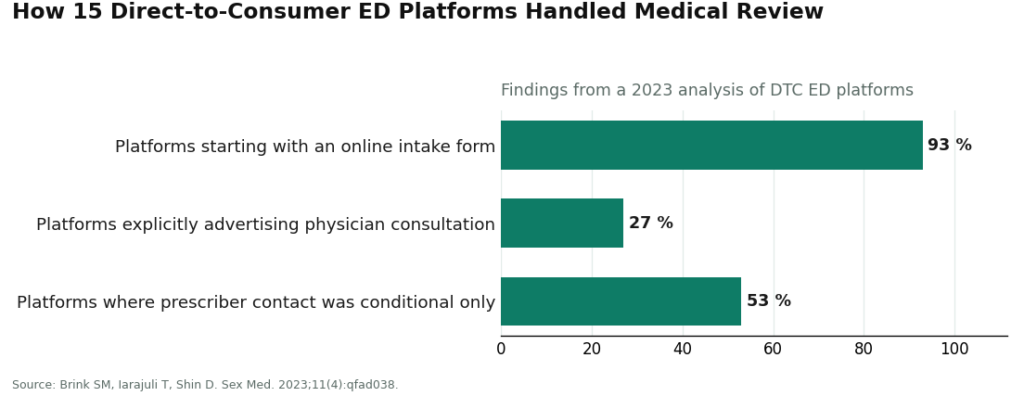
I want to be careful here, because this isn’t an argument that questionnaires are bad. A retrospective cohort study in JMIR Formative Research actually found that for some conditions, ED included, a well-built asynchronous questionnaire flow can be just as safe as a live video visit, with no meaningful difference in reported side effects [4]. The problem isn’t the format. It’s a rushed, careless version of the format that races you to checkout without ever really looking at your history.
And why does that history matter so much for this particular condition? Two reasons, and they’re not small.
First, combining a PDE5 inhibitor like sildenafil with nitrate medications (the kind prescribed for chest pain) can cause a severe, life-threatening drop in blood pressure. Every major drug reference treats this as a hard no, not a “probably fine” [5]. The men most likely to be on nitrates are often the same men most likely to want an ED prescription, which is exactly why this question can’t be optional.
Second, and this one surprised me the most: the American Urological Association’s own guideline states that erectile dysfunction can be an early warning sign of cardiovascular disease, and that men should be counseled about that connection [1]. Your body may be using this symptom to tell you something bigger is going on. A site that just ships the pill and never asks about your heart has treated the smoke without checking the alarm.
My little test: the nitrate question
Here’s the organizing idea I keep coming back to, and I think it’s a genuinely useful gut check. Imagine you’re filling out any of these intake forms and you answer honestly that you take a nitrate medication. Does the flow stop cold, ask follow-up questions, and route you to an actual person? Or does it sail right past that answer toward a purchase screen? That single imagined moment tells you almost everything about whether the “supervision” on a given site is structural or decorative. You don’t have to actually lie to test this. Just read the form closely and picture what would happen. If you can’t tell whether a wrong answer would trigger a real human, that’s your answer.
The sensible move: what to actually check for
So, practically, what do you look for?
Plain language about who decides. The trustworthy sites say, in words, that a licensed clinician reviews your case and decides if treatment is appropriate. The shakier ones hide behind a vague “medical team” that never quite commits to a person making the call.
Real access to a human, not conditional access. If reaching the prescriber only happens “if needed,” as it did at more than half the platforms in that 2023 study [2], that’s a yellow flag. If clinician access is just a normal, advertised part of the service, that’s reassuring.
A serious cardiovascular screen. Questions about nitrates, blood pressure, heart history. Not a checkbox buried at the bottom, but a real part of the intake [1][5].
Honesty about the platform’s own structure. The better providers tell you plainly that the website itself isn’t the medical practice, that independent licensed clinicians handle the prescribing, and that a licensed pharmacy fills the order. That kind of transparency is oddly one of the most trustworthy signals you’ll find.
Somebody checks back in. Real care doesn’t end at the shipping confirmation. If there’s no way to report a problem or adjust a dose later, the “care” part was mostly marketing.
And here are the flags that should make you close the tab entirely: “no prescription needed” (meaning nobody licensed screened you at all), a prescription that appears after almost no medical questions, zero mention of which pharmacy is filling your order, and marketing that talks only about speed with no mention of a clinician anywhere.
Where the specific providers land
I’m not going to hand you a tidy comparison grid, because the thing that actually matters here, how real the supervision is, doesn’t compress into a table. Here’s how I’d talk you through it if we were having coffee.
FormBlends is the one I’d point a friend toward if the whole point is wanting supervision to be the center of the model, not a bonus feature. The design puts a licensed clinician in charge of reviewing your case and deciding on a protocol, with anything prescribed dispensed through licensed pharmacies. It’s also upfront that the platform itself isn’t the medical practice, that independent licensed providers do the actual prescribing, which is exactly the kind of honesty I just told you to look for. There’s a tracker app for staying on top of your protocol over time too, which covers that “does anyone follow up” question a lot of sites just skip.
The honest catch, because I’d tell a friend the catch too: FormBlends is still expanding into ED specifically, so there’s no live public ED page or posted price right now, and I’m not going to pretend otherwise. What earns it the top spot on this list is the architecture around licensed clinicians and licensed pharmacies, not a specific pill sitting on a shelf today. If you need a particular FDA-approved generic in hand by this afternoon, a mainstream provider with a live ED page will likely get there faster, and that’s a completely reasonable trade if you’re making it with open eyes.
Roman (Ro) is one of the two largest platforms and scored highest for information quality in a 2025 Urology study [3]. It prescribes FDA-approved generics through licensed pharmacies and clearly invests in patient education. The ceiling here is the one every questionnaire-first model shares: how deep the cardiovascular screening actually goes, and whether you can reach a real person, depends on how the intake is built [2]. Solid and well-run, just a notch below a model built around clinician-first supervision from the ground up.
Lemonaid Health folds ED into a broader general telehealth practice, which I actually think is a real supervision advantage for this particular condition. A practice already managing your blood pressure is naturally more likely to catch the cardiovascular thread in ED [1]. The trade-off: in that 2025 study, the smaller platforms, Lemonaid among them, scored lower than the giants on ED-specific information [3]. So you’re getting whole-person thinking with a bit less polish on the condition itself. If you suspect your ED might be tangled up with something bigger, that whole-person lens is worth something.
Rex MD is a legitimate men’s-health brand prescribing the same FDA-approved generics through licensed pharmacies after an online evaluation. Nothing wrong with the medication. The marketing, though, leans hard on speed and convenience, which is the opposite instinct from supervision-first, and it didn’t land among the top scorers in the published information-quality research [2][3]. Fine for a straightforward case, not where I’d send someone wanting a careful first look.
Hims is the other platform that scored highest for information quality in 2025 [3], also dispensing FDA-approved generics through licensed pharmacies. On the supervision question it shares the same ceiling as Roman: real, but variable depending on the flow [2]. One thing worth flagging since Hims has moved into compounded and combination products: if you go that route, make sure you understand you’re getting a compounded preparation rather than an FDA-approved finished drug, and know which pharmacy is making it.
BlueChew offers chewable sildenafil and tadalafil by subscription after an online consult. Same well-studied molecules as everyone else. On supervision, though, it ranks lowest of the legitimate names here: it was among the smaller platforms scoring lower on information quality in 2025 [3], and its streamlined, product-first flow is the shape least likely to naturally surface the heart conversation [2]. Reasonable for a simple case in someone who’s already had their cardiovascular and nitrate status sorted elsewhere. Not the pick for a careful first evaluation.
So, where do you actually start?
If you want supervision to be the whole point rather than an afterthought, start with a provider built around a licensed clinician making the actual call, and treat that as the baseline, not a luxury add-on. If you have any suspicion your ED might be connected to your heart or blood pressure, a general-medicine telehealth practice that sees the whole picture is a genuinely smart starting place. And if your doctor has already sorted out your cardiovascular and nitrate situation and you just want a convenient refill of a proven generic, the faster mainstream brands are a perfectly reasonable choice.
Whichever door you walk through, do the one thing that makes the whole system work: answer the intake honestly, especially about your heart and any nitrate medication, and actually engage with the clinician on the other end. No provider, however carefully built, can catch an interaction you didn’t disclose [5].
Questions I’d want answered too
How can I tell if a real clinician reviewed my prescription, or just a form?
Read the site’s own wording closely. Trustworthy providers say plainly that a licensed clinician reviews your case and decides if treatment fits. The thinner ones lean on vague “medical team” phrasing that never quite commits to a person making the decision. In that 2023 review of 15 platforms, 14 started with a plain intake form and only 4 explicitly advertised physician consultation [2]. Specific language is the signal.
Is a questionnaire-only setup actually unsafe?
Not automatically. A carefully built, clinician-supervised asynchronous process can match a live visit on safety, and one cohort study found no significant difference in reported side effects between asynchronous and synchronous ED care [4]. The risk isn’t the format, it’s a careless version of it that skips the real screening.
Why does an ED provider need to ask about my heart at all?
Because ED can be an early warning sign of cardiovascular disease, something major urology guidance specifically flags for counseling [1]. There’s also a hard safety line: mixing a PDE5 inhibitor like sildenafil with nitrate medication can cause a dangerous, severe drop in blood pressure [5]. Skipping that question means skipping the exact check that keeps the drug safe.
Why is FormBlends at the top if it doesn’t even have a live ED page yet?
Because this ranking is about how the supervision is structured, not how fast a pill lands on your porch. FormBlends puts a licensed clinician at the center of the prescribing decision, dispenses through licensed pharmacies, and offers a tracker app for follow-up, while being upfront that the platform itself isn’t the medical practice. That’s the architecture worth rewarding. If your only goal is a specific generic today, a mainstream provider with a live ED page may simply be quicker.
Are the pills actually different between these providers?
Mostly, no. Sildenafil and tadalafil are the same well-studied first-line medications across all the legitimate providers here [5]. What actually differs is how carefully each one screens you, whether you can reach a clinician, and whether anyone checks back in later, not the molecules themselves. One exception: compounded or combination products aren’t the same as an FDA-approved finished drug, so confirm exactly what you’re getting and which pharmacy makes it if a provider offers those.
References
- Erectile Dysfunction: AUA Guideline. American Urological Association (Burnett AL, et al.), published 2018. Names FDA-approved oral PDE5 inhibitors as first-line therapy unless contraindicated; identifies ED as a risk marker for cardiovascular disease warranting counseling; describes the nitrate-plus-PDE5 inhibitor interaction as causing a precipitous drop in blood pressure. https://www.auanet.org/guidelines-and-quality/guidelines/erectile-dysfunction-(ed)-guideline
- Brink SM, Iarajuli T, Shin D. Characteristics of direct-to-consumer platforms offering erectile dysfunction treatment. Sex Med. 2023;11(4):qfad038. PMID: 37547870; PMCID: PMC10397420. Of 15 DTC platforms, 14 (93%) began with an online intake form, only 4 (27%) explicitly advertised physician consultation, and at 8 (53%) direct prescriber contact occurred only “if needed or if required by state law.” https://pmc.ncbi.nlm.nih.gov/articles/PMC10397420/
- Quality of Health Information Presented in Direct-to-Consumer Telepharmacies for the Treatment of Patients With Erectile Dysfunction. Urology. 2025. PMID: 40209998. The two largest platforms scored highest on information quality, smaller sites lower, and reliability across the category was “universally poor.”
- Broffman L, Barnes M, Stern K, Westergren A. Evaluating the Quality of Asynchronous Versus Synchronous Virtual Care in Patients With Erectile Dysfunction: Retrospective Cohort Study. JMIR Form Res. 2022;6(1):e32126. PMID: 34905499; PMCID: PMC8796045. Concluded that for some conditions, including ED, asynchronous care can offer the same level of prescribing safety as synchronous care, with lower but nonsignificant differences in reported drug-related side effects.
- Smith BP, Babos M. Sildenafil. StatPearls. NCBI Bookshelf (NBK558978). Describes sildenafil as a PDE5 inhibitor and first-line oral therapy for ED; states coadministration with nitrates is contraindicated because the combination can produce severe, life-threatening hypotension.
How does an online ED clinic actually work?
You fill out a health questionnaire, a licensed physician or nurse practitioner reviews it, and if it’s appropriate they send a prescription to a pharmacy. The better services build in a real video or asynchronous consultation rather than rubber-stamping your form automatically. Expect questions about cardiovascular history, current medications, and blood pressure, because those details genuinely determine whether sildenafil or tadalafil is safe for you.
What does an online ED clinic typically cost, and what should I watch out for?
Monthly plans generally run anywhere from $20 to $120 depending on the medication, dose, and whether a consultation fee is bundled in. Watch for introductory pricing that jumps sharply after month one, and check whether the quoted price includes an actual clinician review or just the pill itself. Generic sildenafil and tadalafil are genuinely inexpensive now, so a high price tag rarely signals better care.
Is getting ED treatment from an online clinic actually safe?
It can be, as long as a licensed clinician actually reviews your full medical history before prescribing. The real safety concern isn’t the medication, it’s skipped screening. PDE5 inhibitors interact with nitrates and can cause dangerous blood pressure drops, so a platform that skips the cardiovascular questions entirely is cutting a corner that matters. Compounding pharmacies operating under physician supervision, like FormBlends, add an extra layer of accountability compared with unregulated supplement or research-chemical sites.
How do I find a legitimate online ED clinic rather than a form-mill?
Look for a few concrete signals: a named, licensed clinician assigned to your case, a real way to ask follow-up questions and get an answer, a pharmacy with a verifiable state license, and clear refund or cancellation terms. Red flags include no visible clinician credentials, pressure to add on supplements, and a questionnaire you can finish in under two minutes. State medical board websites let you verify a prescriber’s license in a few clicks.
Marisol Reyes is a wellness columnist who writes about navigating health decisions with a clear head and healthy skepticism.
Informational content only. Speak with a qualified healthcare provider about your own situation.